
Award-winning. Passionate. Strategic. Driven.
You’ve read that sentence before – probably on my old LinkedIn profile. And on 47,000 other designer profiles.
It wasn’t a lie. But it also wasn’t helping. Zero DMs from potential clients. Plenty of recruiter spam for roles I didn’t want.
I’m a designer. I’ve led product design across enterprise tools, scaling platforms, internal systems, and launch-day MVPs. But you wouldn’t know that from my old profile. It read like I wasn’t sure who I was talking to.
That’s a problem when you’re trying to attract the right clients to your UX design services.
Why Most Designer LinkedIn Profiles Sound the Same (And Why That’s Killing You)
Designer LinkedIn profiles fall into two camps:
Camp 1: The Resume Upload “Award-winning UI/UX designer with 8+ years of experience across diverse sectors including tourism, automotive, entertainment, healthtech, fintech…”
Which is the design equivalent of saying: “I like people and enjoy solving problems.” Cool. Not memorable. Not positioning.
Camp 2: The Buzzword Buffet “Passionate multidisciplinary product thinker focused on human-centered design thinking to create intuitive digital experiences that delight users.”
Which translates to: “I do design, probably.”
Neither tells me what you actually do, how you work, or why I should email you.
The problem isn’t that these phrases are wrong. They’re just wallpaper. Everyone says them. No one believes them. They don’t differentiate you from the 15 other designers the founder looked at this week.
And if you’re trying to build an audience or position yourself as something other than a commodity, vague positioning kills you.
What Clients Actually Look For in Designer LinkedIn Profiles
When a founder or product lead is desperately searching for design help at 11 PM, they’re not reading your profile like HR reviews resumes. They’re scanning for signals:
- Do you understand my specific problem?
- Not “I do UX” but “I fix onboarding flows that lose 60% of signups”
- Have you worked on things like mine?
- Not sector list but “I’ve scaled SaaS products from MVP to 10K users”
- Will you be annoying to work with?
- Your tone tells them if you’re a consultant who lectures or a partner who ships
- Are you actually available?
- Freelancer? Agency? Full-time? Looking? Not looking?
Your LinkedIn profile for designers needs to answer these in the first 3 lines. Everything else is bonus.
I wasn’t answering any of them. My profile said “I’m qualified” but not “I can help you.”
The Before/After: Rewriting Your Designer Bio Line by Line
I treated my profile like a UX problem. User: startup founder, overwhelmed, scanning 10 profiles. Pain point: everyone sounds the same. Goal: make them pause and think “I’d like to talk to this person.”
Here’s what changed:
| Before | After |
|---|---|
| “Award-winning UX/UI designer with 8+ years of experience…” | “I design the part of your product people complain about.” |
| “Helping businesses create intuitive digital experiences.” | “You know that screen no one wants to touch? That’s my happy place.” |
| “Focused on clean interfaces and best practices.” | “I design calm — even when your sprint board screams.” |
Each line does one thing: tells the truth quickly. Doesn’t apologize for having an opinion. Doesn’t try to be for everyone.
You wouldn’t put lorem ipsum in your UI. Why are you filling your LinkedIn profile for designers with it?
LinkedIn Profile Sections That Matter for Design Clients
Your Headline (Don’t Waste It)
Most designers write: “Senior UX/UI Designer | Figma | User-Centered Design”
Which tells me you know how to use tools. Congratulations.
Better: “Product Designer | I fix SaaS onboarding that loses 60% of trials”
Or: “UX Partner for B2B Products | Dashboards, workflows, things your users actually use”
The formula: [What you are] | [Specific problem you solve] or [Type of work you’re known for]
About Section (Kill the Feature Dump)
I used to list every skill: “Proficient in wireframing, prototyping, user research, design systems, interaction design, visual design…”
That’s a LinkedIn skill tag, not positioning.
Now I open with: “I design the part of your product people complain about.” Then 3-4 short paragraphs about how I work, what I’m good at, what I’m not good at.
Specificity filters. And filtering is the point.
Experience Section (Stories, Not Tasks)
Instead of:
- “Led design for 15+ features”
- “Collaborated with cross-functional teams”
- “Improved user satisfaction by implementing best practices”
Try:
- “Redesigned onboarding flow – cut 8 steps to 3, activation up 40%”
- “Fixed dashboard nobody used – turned out it showed wrong metrics”
- “Built design system devs didn’t ignore (first time for everything)”
Real problems. Real outcomes. Occasional dry humor about what designers actually deal with.
Common LinkedIn Mistakes That Make You Look Like Everyone Else
Mistake 1: The Skill Laundry List
“Skilled in Figma, Sketch, Adobe XD, InVision, Miro, FigJam, Principle, Framer, Axure…”
Nobody cares. Everyone uses Figma now. If you’re still listing tools, you’re dating yourself.
Mistake 2: The Sector Buffet
“Experience across fintech, healthtech, edtech, proptech, insurtech, martech…”
Translation: “I’ve done some freelance projects.” Which is fine, but don’t pretend sector hopping makes you an expert. Pick one or two you’re actually good at.
Better: “I work with B2B SaaS teams fixing post-MVP chaos.”
Mistake 3: The Humble Brag Wall
“Humbled to share I was recognized as…” “Grateful to announce…” “Excited to have been selected…”
Stop. You sound like you’re accepting an Oscar. Just say what you do.
Mistake 4: The AI-Generated About Section
If your About section includes phrases like “leverage,” “synergy,” “holistic approach,” or “end-to-end solutions,” you either used ChatGPT or you’ve been in corporate too long.
Rewrite it like you’re explaining your work to a friend. Not like you’re writing for algorithms.
Mistake 5: No Clear Call to Action
What should someone do after reading your profile? Email you? Book a call? Check your portfolio? Don’t make them guess.
I added: “If your product’s a mess, let’s talk: [link]”
Simple. Direct. Filters people who aren’t serious.
How Your LinkedIn Voice Filters Clients (And Why That’s Good)
The best copy doesn’t just say what you do. It says who you’re for – and who you’re not.
When my profile said “collaborative problem-solver with a user-focused mindset,” every type of client thought I was for them. Including the ones with 17 stakeholders and no decision-making authority.
Now my profile says “I design the part of your product people complain about.” Founders with real problems email me. People looking for someone to make their landing page “pop” don’t.
That’s the point.
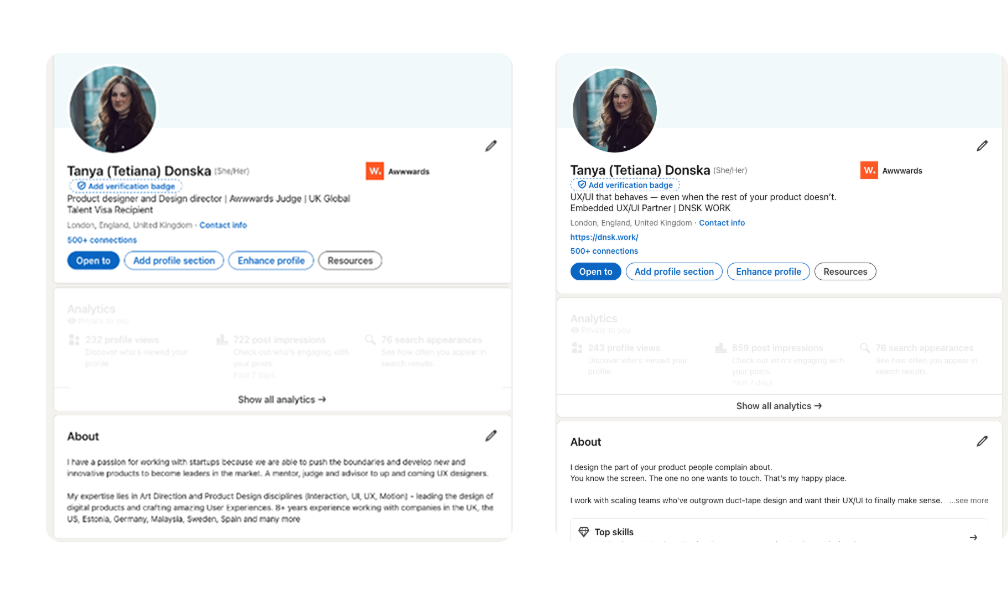
Your LinkedIn profile for designers isn’t a net – it’s a filter. The goal isn’t to appeal to everyone. It’s to attract the clients you actually want to work with, and save yourself the awkward discovery calls with the ones who’ll waste your time.
Voice is a design decision. Tone matters. Specificity matters. Every line is positioning.
If your profile reads like it was written by someone trying to please a hiring committee, rewrite it. If it sounds like it could belong to any other designer – rewrite it. If it doesn’t make you smile just a little bit when you read it back – definitely rewrite it.
Say what you actually do. Be clear. Be a little bold. Be human.
Because nobody wants to hire a buzzword. They want to hire you.