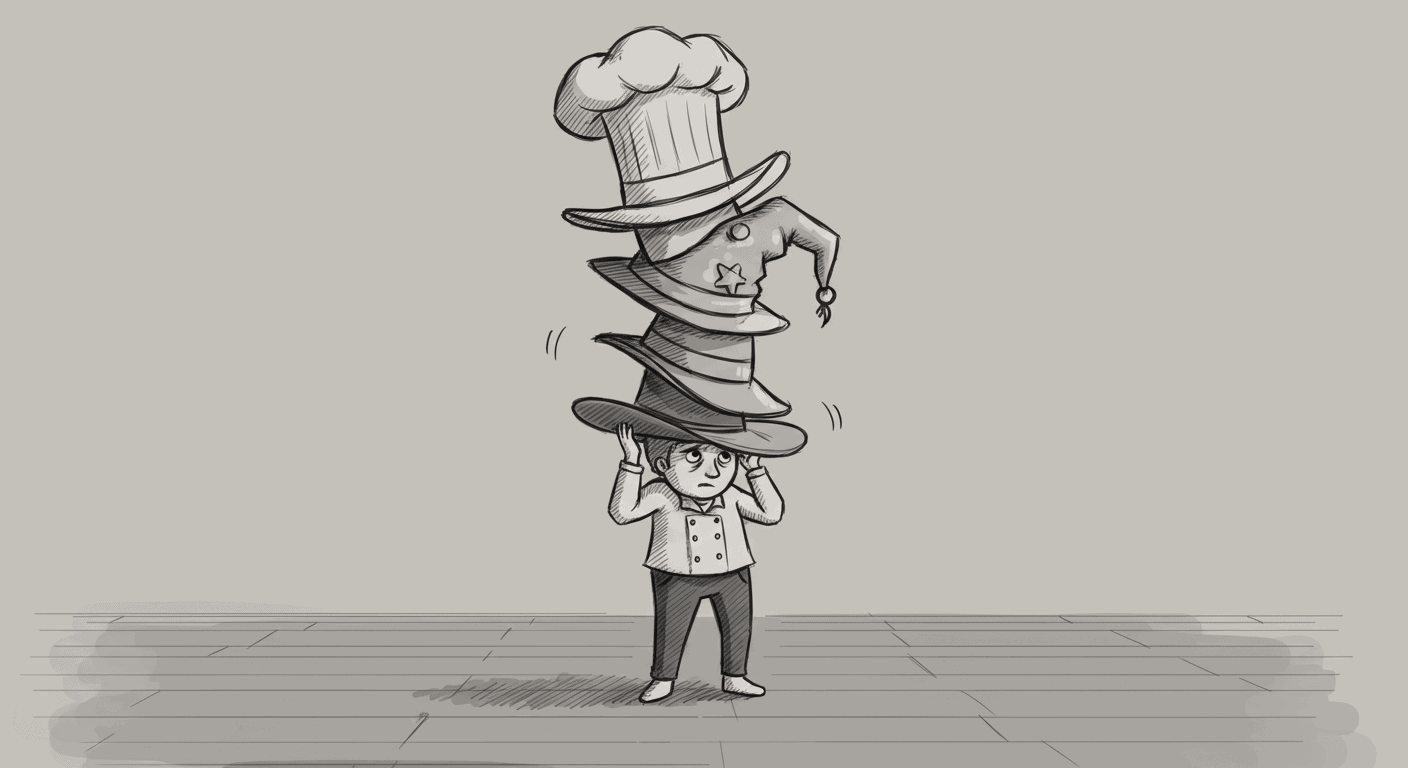
I spent eight months working as Creative Director for a large, well-funded product team. Big budget, talented people, genuine ambitions.
Watched them add features like collecting Pokémon cards. CRM. Then dashboards. Then analytics. Then automation. Then AI (of course).
Each addition made perfect sense in isolation. Each one had a business case, user requests, competitive pressure justification.
Together? They created a product that did seventeen things adequately and zero things exceptionally.
This isn’t theory. This is what bad SaaS product strategy looks like from the inside.
Why “All-in-One” Seduces Founders (The SaaS Product Strategy Trap)
“All-in-one” sounds efficient. Intelligent. Maybe even visionary.
Reality: you’re building a bloated toolbox full of half-broken features that look impressive in pitch decks but fail in daily use.
The pitch is irresistible to everyone involved:
- Founders imagine capturing every workflow under one roof
- Investors see infinite upsell opportunities and higher valuations
- Sales teams love saying “yes, we do that too”
- Marketing gets to claim “one tool for everything”
Feels like a shortcut to category dominance.
It’s not. It’s a shortcut to mediocrity at scale.
Most SaaS product strategy discussions I’ve sat through focus on potential market size instead of actual user pain. They prioritize breadth over depth, mistaking optional add-ons for meaningful solutions.
Result: a product that checks boxes for everyone but truly satisfies no one.
(Including the team building it. But more on that later.)
The Large Product Team Where I Watched This Happen
The team started with a focused email tool. Clean, simple, did one thing well.
Then Series B funding arrived. Suddenly the roadmap exploded.
Month 1: “Users are asking for CRM features.” Month 3: “Competitors have landing page builders, we need one.” Month 6: “We should add analytics.” Month 9: “AI is hot, let’s integrate it everywhere.”
Each feature took 2-3 months to build, launched half-finished, got minimal adoption, created maintenance burden forever.
I watched designers compromise consistency to handle a zoo of use cases. Engineers maintaining code paths nobody used. Support drowning in edge cases from features 4% of users touched.
The product went from focused tool to everything bagel. Users noticed.
Churn started climbing. Not dramatically—just a steady 2-3% monthly increase that compounded into a real problem by month six.
Leadership response? “We need more features to reduce churn.”
(This is what happens when your SaaS product strategy is dictated by competitor feature lists instead of user needs.)
How Feature Bloat Kills Focus
Every new feature added to an all-in-one product is another leak in the focus bucket.
Instead of doubling down on solving one core problem brilliantly, you spread thin across shallow add-ons.
At the large product team:
- Support tickets tripled (from 200/week to 600/week in five months)
- Average response time went from 4 hours to 26 hours
- Documentation became a maze (47 help articles for “email campaigns” alone)
- Onboarding flow had 12 steps trying to explain everything
Users sense when a tool feels coherent versus duct-taped. The UI starts to creak. Performance lags. Workflows feel like wandering through a half-finished store.
Trust erodes. And once trust cracks, you can’t glue it back together.
What This Does to Your Team
Bad SaaS product strategy doesn’t just hurt users. It destroys teams.
What I saw happen over eight months:
Design team:
- Every feature needed different UI patterns
- Design system fell apart (14 button variations by the end)
- Spent 60% of time on meetings debating “which features to prioritize”
- Zero time for actual UX improvements
Engineering:
- Technical debt compounding weekly
- New features breaking old features
- 40% of sprint capacity went to maintenance
- Best engineer quit (cited “we’re building nothing well”)
Support:
- Couldn’t keep up with ticket volume
- Had to learn seventeen different workflows
- Most questions were “how do I do X” (features buried too deep)
- Empty states were disasters because nobody designed for them
Leadership:
- Constantly firefighting
- No clear product vision anymore
- Metrics looked okay (adding features = temporary engagement spike)
- Didn’t notice the foundation crumbling
This is what happens when “add more features” becomes your default SaaS product strategy.
Real Example: Cold Email Tool That Lost Its Way
Can’t name the product, but you’ve probably seen it.
Started as focused cold email platform. Clean interface. Did personalization well. Sales teams loved it.
Then they added:
- Built-in CRM (mediocre)
- Landing page builder (worse than free alternatives)
- Meeting scheduler (barely functional)
- LinkedIn automation (against LinkedIn ToS, caused account bans)
Each feature launched with big announcement. Each one drove temporary signup spike. None of them retained users.
Current state: serviceable for cheap lead gen, but serious sales teams use it alongside four other tools. The all-in-one promise failed because each piece was half-baked.
Watched their support forum. Same pattern every month:
- “When will CRM feature X work?”
- “Landing pages are broken on mobile”
- “Meeting scheduler double-booked my calendar”
Meanwhile, their core email feature barely improved for two years.
That’s what bad SaaS product strategy looks like: abandoning what you do well to chase what competitors do.
The Silent Churn Pattern I Saw
Churn in all-in-one products rarely looks dramatic.
It’s a slow fade-out.
At the large product team, I tracked this pattern across 40+ churned accounts:
Month 1 after signup:
- Using 6-7 features
- High engagement
- Positive feedback
Month 3:
- Down to 3-4 features
- Support tickets increasing
- Complaints about complexity
Month 5:
- Using 1-2 features only
- Exporting data to specialist tools
- “Evaluating alternatives”
Month 7:
- Cancelled
- Exit survey: “Found better fit“
- Actually meant: “Found tool that does one thing well”
Users don’t rage-quit all-in-one products. They slip away because they never felt truly understood.
Your retention graph starts looking like a gentle ski slope. (No investor wants to ski down that.)
What Good SaaS Product Strategy Actually Looks Like
The best SaaS products don’t try to do everything.
They pick a painful, specific problem and annihilate it.
Characteristics I’ve seen in focused products:
They have clear “not our job” boundaries:
- “We do X, not Y”
- “If you need Y, use [other tool] – here’s the integration”
- Users respect this clarity
They measure depth, not breadth:
- Not: “How many features do we have?”
- But: “How well does our core feature solve the core problem?”
They expand thoughtfully:
- New features feel like natural extensions
- Not desperate grabs at adjacent markets
- Each addition makes the core stronger
They earn trust through focus:
- Users recommend them unprompted
- “Best tool for X” (not “does everything okay”)
- Real loyalty, not trapped by switching costs
This is what sustainable SaaS product strategy looks like: winning deep before going wide.
Build Narrow, Win Deep
At the large product team, I tried pitching this approach multiple times.
“What if we removed 60% of features and made the core email tool exceptional?”
Response: “We’d lose revenue.”
(They lost revenue anyway. Just more slowly.)
The math on focused products:
- Fewer features = less maintenance = more improvement velocity
- Better at one thing = higher NPS = more referrals
- Clear positioning = easier sales = lower CAC
- Loyal users = better retention = higher LTV
“All-in-one” often ends up meaning “adequate at most, irritating at worst.”
If you wouldn’t trust one tool to fix your plumbing and cater your wedding on the same day, why trust it to run your business?
How to Fix Your SaaS Product Strategy: Resisting the All-in-One Temptation
Practical advice from watching this mistake happen:
1. Write your “not our job” list Be explicit about what you won’t build. Publish it. Repeat it in meetings when someone suggests scope creep.
2. Track feature adoption ruthlessly If <20% of users touch a feature in 30 days, kill it or fix it. Don’t let zombie features accumulate.
3. Measure “depth of use” not “breadth of features” Better metric: “Do users accomplish their core job faster/better than alternatives?”
4. User research that matters Not: “What features do you want?” But: “What job are you trying to do? Where does our tool fail you?”
5. Expansion criteria New feature only ships if it makes the core job easier. Not adjacent jobs. The same job.
6. Watch your best users, not your loudest Power users who get real value rarely ask for more features. They ask for the existing ones to work better.
7. Check your roadmap’s focus If 60%+ of your roadmap is “new capabilities,” you’re doing breadth strategy. If 60%+ is “improve existing capabilities,” you’re doing depth strategy.
Most winning SaaS product strategy is depth-first.
The large product team eventually course-corrected. Took a new CPO, a down round, and eighteen months of painful decisions.
They killed 11 of 17 features. Focused entirely on the core email tool. Rebuilt it properly.
Churn stabilized. NPS went up 40 points. Sales got easier because positioning was clear again.
But they lost two years and $8M learning what focused products knew from day one:
Your users don’t want everything.
They want the right thing – built properly, maintained with care, and delivered with confidence.
Resist the buffet strategy.
Be the focused, exceptional restaurant people cross town for. The place they brag about to friends. The one they keep coming back to because it delivers exactly what they need, without compromise.
That’s sustainable SaaS product strategy.
Not “we do everything.”
But “we do this one thing better than anyone else.”